What You Can do About the Okta Compromise
News this week brought us word of something very disappointing, a breach in a large player in the identity services company, Okta. If I’m being 100%...

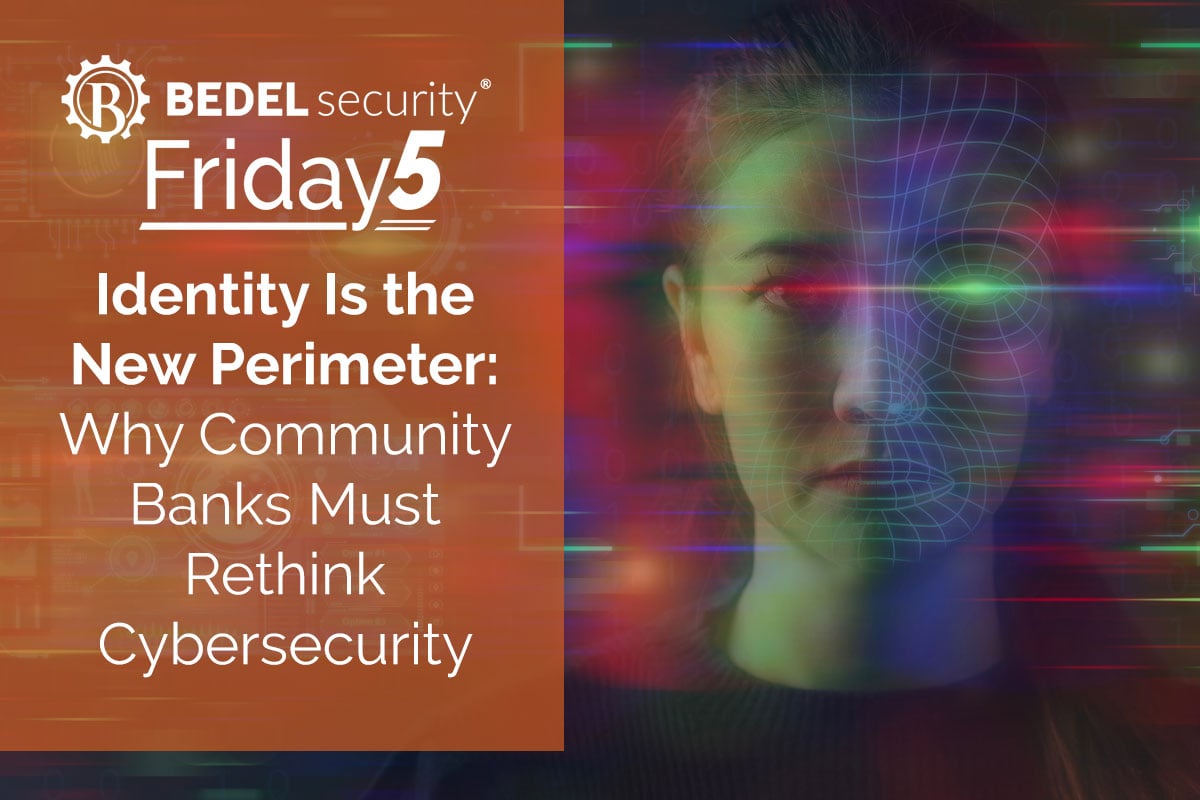
For years, cybersecurity strategies were built around a clear boundary: the network perimeter. Firewalls, intrusion detection systems, and network segmentation formed the front line of defense. But that model no longer reflects how modern attacks succeed—especially in the banking sector.
Today, most successful breaches don’t start with a network exploit. They start with a compromised identity.
For community banks, this shift has major implications. Employees, vendors, cloud services, and even automated systems authenticate from anywhere, often through cloud‑based platforms. Attackers know this, and they increasingly focus their efforts on stealing, abusing, or forging identities rather than breaking through technical controls.
Modern banking environments are built on trust relationships. When a user logs in, a system doesn’t just check a password—it relies on identity assertions: digital statements that confirm who the user is, how they authenticated, and what they are allowed to do.
These identity assertions are exchanged constantly:
If an attacker can compromise or manipulate those assertions, they don’t need to bypass security controls—the system lets them in.
This reality is now explicitly recognized in NIST Cybersecurity Framework (CSF) 2.0, which places identity management squarely within the Protect function.
NIST CSF 2.0 introduces a specific outcome under the Protect function:
PR.AA‑04: “Identity assertions are protected, conveyed, and verified.”
In simple terms, this outcome acknowledges that:
This is not an abstract technical concept. It reflects how real‑world breaches occur—often through compromised credentials, session hijacking, or abuse of trusted identity relationships.
For community banks, identity‑centric attacks often surface as:
In many of these cases, security tools function exactly as designed. The problem isn’t that controls failed—it’s that the system trusted the wrong identity.
Community banks face a unique challenge. Their environments are often just as complex as larger institutions, but with smaller teams and tighter budgets. At the same time, regulatory expectations for cybersecurity maturity continue to rise.
Attackers understand this balance. Rather than attempting noisy network attacks, they target identity workflows that appear legitimate and are less likely to trigger alerts.
From a risk perspective, identity compromise turns cybersecurity into an operational risk:
NIST CSF 2.0 does not prescribe specific tools, but it does clarify outcomes. For PR.AA‑04, alignment generally means ensuring that identity assertions are:
These principles apply whether the identity belongs to an employee, a service account, or a third‑party vendor system.
Importantly, this is not just an IT concern. Identity assurance intersects with governance, vendor management, incident response, and business continuity planning.
Many organizations stop at passwords and multi‑factor authentication. While MFA is critical, it is not sufficient on its own. Identity assertions still need to be protected after authentication occurs.
Community banks should be asking broader questions:
These questions map directly back to CSF 2.0’s emphasis on identity assurance and protection.
The most important takeaway is this: cybersecurity is no longer about defending a location—it’s about validating trust.
By aligning identity practices with NIST CSF 2.0 outcomes, like PR.AA‑04, community banks can move toward a more realistic security model—one that reflects how attacks actually occur today.
Identity may be invisible, but it has become the most critical control in the modern banking environment. Treating it as such is no longer optional.
News this week brought us word of something very disappointing, a breach in a large player in the identity services company, Okta. If I’m being 100%...
This article is the second of a 2-part series on building an effective outsourcing strategy for the various components of IT for financial...
In late August, the FFIEC announced that they would sunset the Cybersecurity Assessment Tool (the “CAT”) on August 31, 2025. It had been apparent...